Friday, 18 April 2014

The Evening Restaurant

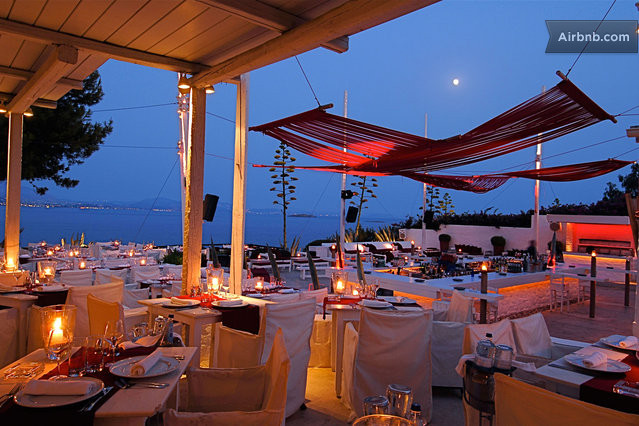
The evening restaurant on Apollo Street opened only in the dark. Its light blue walls, outside the restaurant, matched the azure skies that overlooked it. The menu contained two meals: Fried Golden Fish, Vegetable Salad and No Drink.


Mr. Pig owned the restaurant. His father, Mr. Horse, bequeathed it to him. Mr. Pig has two employees: Mrs. Chicken and Mr. Porcupine. Mr. Pig took orders and served dishes; Mrs. Chicken made vegetables while Mr. Porcupine fried the golden fish. The evening restaurant used to open twenty-four hours, seven days of the week and three hundred and sixty-five days of the year during Mr. Horse's time but Mr. Pig always believed that evening meals were the most important, that any food eaten in dark was the sweetest and it must be vegetable salad plus golden fish with no drink.


The clean sea by the evening restaurant brought in yellow airs and green noises from far lands. He saw the air enter, heard it rearranging plates and spoons, witnessed it dancing around the three thousand square feet space and felt it gently tapping his chubby cheeks. It lifted the red table clothes, moved the napkins and went out through an open window near the toilets. He prayed for the hundredth time that nature threw in his first customer. 

            After three seven seasons of bright rain, dusty sun and heavy harmattan, the first customer, since Mr. Horse galloped to the other side,  stumbled into the evening restaurant. The customer wore a white tuxedo suit, an orange bow tie, white shirt and a dark pair of Ray Ban shades. He found his way to the first seat and placed himself on it.

            A fresh stream ran across Mr. Pig’s heart. His wide smile revealed his golden teeth; he cracked his fingers and watched his expensive looking customer. He sniffed in the perfume of the customer and noticed as the man looked around his beautifully arranged restaurant.

            “Welcome,” Mr. Pig spoke with excitement, “to the best restaurant in the world where we serve the most important meal of the day.”

            “Can I see your menu?” asked the customer.

            Mr. Pig rushed to the customer’s table and pushed the menu closer to the man’s right hand. He studied as the man tried to feel the words on the paper.

            “What do you serve, Mr.?”

            “The menu is right in front of you.”

            “I see.”

            “You’re not blind, are you?” Mr. Pig queried.

            “Yes, I am.”

            “My first customer can’t be blind! How would he appreciate us? Get up, Mr! Time for you to leave!

            Mr. Pig grabbed the customer by the hand, pulled him up and pushed him out of his restaurant.

            “Not for the blind!”


            Mr. Pig cleaned the table and chair where the blind once sat then resumed his wait for the next customer.  

Wednesday, 9 April 2014

The Ice-cream Girl.

She loves ice-cream. Her best flavours: caramel, vanilla, strawberry, raspberry and banana flavour. Banana stands out. Every morning, she takes three to four scoops before brushing and at night, four to ten scoops before sleeping. Before and after every meal, she takes it. At work, that’s the only thing she thinks of. When she drives to and from work, she has one in hand. Any shape of ice-cream—cone, stick, bowl etc, etc.— is good and she knows how to swallow and lick; lick and swallow.


            Once upon a time, she bought ice-cream named F.  F changed her taste bud because it was her first. She loved it. After months of lick, lick and licking, she left F, threw the stick into the abyss of memory. F also choked her but she misses F because it was her first.  


            That experience made her curious. On her way back to the town of ice-creams, she saw a hawker carrying B. B was cold, dripped water and gifted the air with pristine odours. Excited, she bought it. B was curved on the tip, such that it filled every corner of her mouth. She squeezed and licked it thoroughly.  After the journey, she kept it in her mouth. Her friend saw B in the kitchen; her friend tasted it and stole it. She became angry.


            Angered, she walked, walked and walked until she found herself in a shopping mall where she found U on the floor. She picked U and tasted it. She spat. Spat. She cursed U for spoiling her tastes. U was old. Tasteless.


            For some seasons she stayed away from ice-cream because she could not tell which was sweet or bitter.


            One day, she went into Mr. Biggs and after deep contemplation, she bought R. R was a soft ice-cream. When she tasted it, she screamed: “sweet!” She studied the size and was thrilled by it but R was too soft. R needed electricity to be hard. R likes to be in the fridge a lot because R melted easily. She took R everywhere she went and boasted about R. she promised never to take any other ice-cream. However, whenever she thought of B, she ran to it for quick tastes. She loves ice-cream. She took R and B for a long time until they finished.


            Another season, lost in the middle of nowhere, a friend introduced her to M. She was tempted by the M’s look but she promised not to buy it. Everywhere she went M was there. One taste of M and she was hooked. She bought a mobile Fridge and kept M there. Every morning, every evening, everyday she would lick M. M never finished.


            Even when she left M in the fridge without turning on the switch, it never melted. One day, she went into the market, she was told about K and immediately decided to taste it. She was told that K was on another part of town but she searched for it, found it and bought it. K was big. So big that it almost cut the sides of mouth. After every lick of K, she would go home and top it up with M. That was her new modus operandi.


            When she went to another town. By the bus-stop, she saw a girl carrying V and D. V was long and thing. D sitting on a cone, looked juicy and inviting. She loves ice-cream. She took V, slurped once, twice and thrice and then got bored and threw V away. She picked D and it blew her mind away. She licked it for long. Kept it and went back to M. M never melted. It was there. She licked M like she didn’t know the taste. Then she would return to where D was placed and lick and return to M then lick hard again.


            In another country, she found S. S was big. S was exclusive to another. But S was big and curiosity made her want S. Just three licks and S changed her life. S made her fat. S made her beautiful. S made her tongue red. S made her skin fairer. S increased her height. S made her eyes whiter. S was good, too good.


            Then she started taking S, D and M at different places and different times. She liked M. She like D. But didn’t like S that much. She took D till she got confused that it was M. One day, one sad day, after she took D she went home to take M for top-up like always then found something that changed her life for ever— M had melted and flowed out of the room.


            She still loves ice-cream.


Friday, 31 January 2014

Kissing Democracy Goodbye in Nigeria.

Political corruption is one of Nigeria’s besetting ills, and there has been plenty of it in the so-called democracy, but of course it is not our collective responsibility to care.  There are other important things to do—goals to reach, dreams to dream of and daily battles to conquer.  In that light, kissing democracy goodbye is unavoidably right? False!

It is up to the new leadership in 2015 to show us ‘true’ democracy. The task of cleaning would not be easy but can be done. That new leadership must reject the idea of getting votes by appealing to religious sectarianism, tribalistic jingoism, and petty thuggery.

All parties must desist from bribing and corrupting the supporters and achieve results by the ballot box.  They must show that Nigeria is not in the grip of any new imperium. A definition of Nigerian democracy must be created.

For a nation of one-eighty million to make any kind of sense of democracy, it must base itself firmly on the concept of multiplicity, of plurality and tolerance, of devolution and decentralization wherever possible. There can be no one way—religious or cultural—of being a Nigerian; let difference reign. That is democracy.

But alas, the romantic relationship between certain individuals and the seat of power would be the reverse of Jack Dawson’s love for Rose Dewitt Buktaker on the RMS Titanic ship. Rose must die for Jack to live. In other words, Nigeria must die for them to remain in power.

Those who forget the past are condemned to repeat it. 1966? Nigeria, a delicate child of fifty-four, has not really enjoyed the benefits of democracy. If anything, she has only shared some shards of the scattered definitions of freedom.

There are deep uncertainties about where the country is heading. With events springing up like thorns one may conclude that the kiss is everlasting. Issues: defection of PDP members to APC; Suntai denies rumoured resignation; boko haram; homosexuality and human rights, etcetera, is Nigeria.

It’s easy to say that the new administration, should, and in all likelihood will, attempt to simply change the societal ills; that would be a tricky conclusion. The social malaise is gargantuan. And, the question lingers: who/what is the new administration?

Our knowledge of Mr Goodluck Ebele Jonathan is of an inexperienced leader. Add his team and you have a gathering of languorous elements running the engines of an unstable regime.  What next?

It’s only a matter of months before we can stop this progressive lunacy. What must be done? It is simple: choose the right devil. All politicians are devilishly-good or devilishly-evil.

Many, with good reason, are extremely nervous about the outcome of the approaching general election. Sabre-rattling individuals want GEJ to remain and in other factions, another individual is preferred. The general populace want a human being in power.

Calling Nigeria a democratic state, to many observers, is absurd.  At any rate, the question remains: if the situation of Nigeria continues to deteriorate, will the people be bold enough to turn against the ruling class? What happened after Occupy Nigeria?

Two clichés about Nigeria must be dismissed. First, the probability of a military coup is possible. Second, the idea of a united, democratic, secular Nigeria is attainable under this leadership.

For the moment, however, all of us who are Nigerian by citizenship, or birth, or race, must accept that we are gradually kissing our democracy goodbye. It would be a shame on us all if we let it slide out of our hands.

We must find the strength to act with honour in the months to come. To struggle to retain this freedom before us and to ensure, by any means necessary, that we choose that individual who would lead us, devilishly, into a heaven where we can begin to craft new ideas, reach new heights and burst into new dynasties.

Our stories must not be left in the hands of an unscrupulous few. We have the right to re-shape the plots of our lives and re-define it. Let’s start today.


God bless Nigeria.

Tuesday, 28 January 2014

The Life of a Writer


I wrote my first article when I was eight years old. It was about military oppression in Nigeria. I loved it. But Uncle Monday, my primary school teacher, didn’t like it because he thought I copied it. “I didn’t,” I cried. I was hurt.


Secretly, I continued writing. I wrote for myself. I was scared of what people might say. Fear of scorn and fear of rejection made me embark on necessary nonsensical career journeys.


 To become successful in Nigeria, I was told, you have to be an accountant, an economist, an engineer etc etc. Indeed, I followed the bandwagon. What do I know? For years, I sat at home looking for that university that would admit me into their noble department. My talent suffered.


 A writer’s life might begin with these doubts: whether, truly, he/she is doing the right thing or maybe, just maybe, that professional profession is better. These aporias fuelled a mediocre living.


After four years of waiting and wasting time and JAMBing, I finally made it into university to study literature. The arts called me back. Like Okigbo, I returned to Mother Idoto naked.


I studied various writers’ works and their lives. They have one thing in common, they love words and most of them were considered as weirdoes, geeks and misfits.


As I continued my trip into this sometime solitary life, I discovered some strange truths. First, people you love and those who love you always say something positive about your writings. Even when it is crap, they sing your praise. They encourage you.


Second, there are those, as a writer, you hate to love or love to hate. Those who run around defaming your personality and wishing, most importantly, that you amounted to nothing. Every move you make is devilish in their eyes. That writer smokes heavily, uses drugs, and copulates with two hundred women a day before he writes. These ones add to the spurious myths held about writers.


Depression. Boredom. Energy. Envy. Love. Hate. Madness. Negativity. Positivity. They come, yes. They visit a writer once in a while. And in these moments of visitation, the writer may let the guest rule those hours or decide to rule the guest. Whatever the choice, a result comes out: good, bad and good-bad.


The life of a writer may mean a lot to some and mean nothing to others. For example, in a party, I was dancing to Davido’s Skelewu and, screaming “Skelewu!” until I found myself outside. I met this lady, a conversation ensued and we got to that awkward part where you’re asked, “What you do for a living?” I answered proudly, “I am a writer.” A fake smile emanated. “You look like a banker. You guys try sha. You creative people. It is always good to have you people as friends. You never know. I know what writers are like.”


As a writer, you must learn to work for free most times. Friends, family members and even enemies send you stuff to proofread, re-write, and some tell you stories that need urgent writing. You must not say no. You must not charge. You are supposed to be a voice for humanity. Your pay is in heaven. You can feed your family with your goodness.


Discipline is key. Practise is essential. Every good thing comes to the writer who writes regularly and consistently. Life has made it that way.


The life of a writer is patience and determination filled. Forty rejection letters later, the writer keeps writing. When bills strangle the writer’s neck, when life’s harsh realities punch the writer into a coma, why does he keep composing words?


Story telling is part of a writer’s life. He can conjure characters from the air and make them live. He has the power to make you believe a woman can create gold. He has the power to make you cry, laugh, just to mention those two.


I’m still writing. My life is writing. Writing is my life.


In this career, I’ve learnt lessons. One of them remains important: never give up and never allow what anyone says about you or your work derail you from your set goal(s).